Unifying three separate search databases into one — and building the labeling system that made every item on the platform findable from anywhere.
The challenge
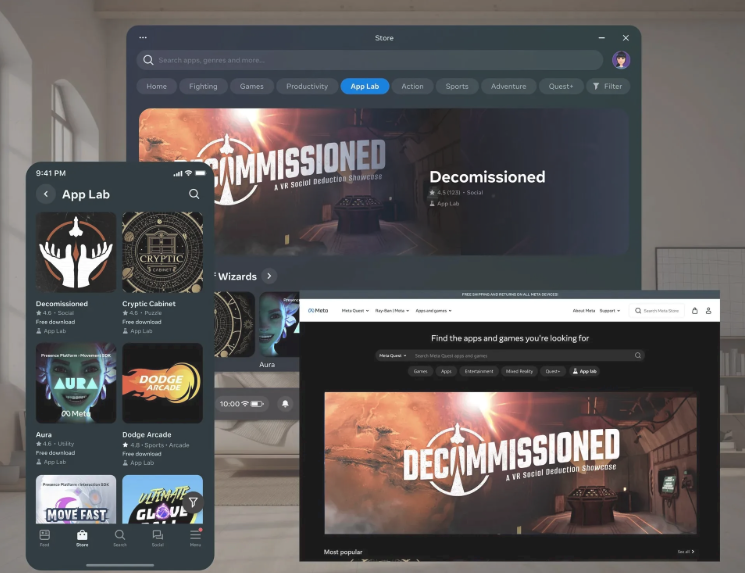
On Meta Quest, search was siloed: the Store, Settings, and Library each had their own search, and a user who didn't already know where something lived had no reliable way to find it. Looking for a setting? Wrong search. Looking for a game you already owned? Different search. It was a friction pattern that compounded with every new app and feature added to the platform.
Merging them into a single Global Search experience wasn't just a technical challenge — it surfaced an enormous content design problem. Every item across the entire system needed to be correctly labeled, appropriately badged, and categorized in a way that made sense regardless of where a user was searching from. The taxonomy had to work for a first-day user and a power user simultaneously.
What I did
I designed the labeling, badging, and indication patterns for Global Search — the content system that determined how every single item on the Quest platform was named, categorized, and surfaced in search results across Store, Settings, and Library.
This meant defining what a "result" looked like depending on its type: how to distinguish an app you own from one you don't; how to label Settings results so they're immediately scannable; how to handle edge cases like content that exists in multiple contexts. I built the terminology framework that made heterogeneous results feel like a coherent, unified system rather than three databases awkwardly stitched together.
The work required close collaboration with engineering (on what data was surfaceable), design (on how results were visually differentiated), and product (on what the search experience needed to prioritize).
The result
Global Search launched as a major HorizonOS update, reducing the steps required to find anything on the platform for the first time in Quest's history. Users no longer had to know where something lived to find it — a foundational improvement to the platform's usability that benefited every user from day one.